Build vs. buy: when stitching open-source scanners together stops scaling
Here’s a take you won’t often hear from a vendor: you should start by building it yourself. The open-source attack-surface tooling is excellent and free. A competent engineer can wire subfinder, dnsx, naabu, httpx, tlsx and nuclei into a cron job in an afternoon and get real value the same week. If you haven’t done that yet, do it before you buy anything.
The honest question isn’t “build or buy.” It’s “when does the DIY stack stop paying for itself?” Because it does, and the costs are sneaky.
What the DIY stack quietly costs you
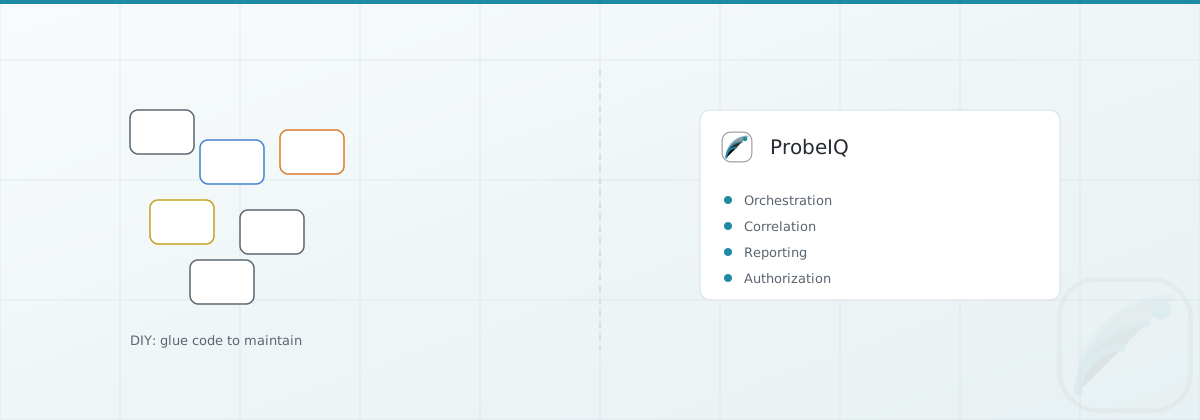
The glue is the real project. Running the engines is trivial. The work is everything around them: de-duplicating findings across tools, correlating them to persistent assets, normalizing severities, storing state so you can diff runs, and rendering something readable. That glue is a real application, and you just became its maintainer.
State and memory. A scanner has no memory. Without a datastore and reconciliation logic, every run re-reports everything, nothing persists your triage decisions, and “this finding came back” is invisible. Building that well is most of what a commercial platform is.
Reporting nobody dreads. Raw JSON is not a report. An executive summary, a technical breakdown, a weekly diff, an asset inventory — each is its own sub-project, and they’re the difference between a tool your org uses and one it ignores.
Authorization and audit. When you scan assets — especially clients’ — you need ownership verification, signed rules of engagement, and a tamper-evident record of what ran, against what, under whose authority. Homegrown, this is easy to do badly and risky to skip. (We go deep on this in The defensible scan.)
Keeping up. Templates update, engines release, new takeover signatures appear, APIs change. The DIY stack is never “done” — it’s a standing maintenance commitment that competes with every other thing on your plate.
The bus factor. All of the above usually lives in one engineer’s head and one repo of shell scripts. When they’re on leave — or gone — so is your ASM program.
When DIY is genuinely the right call
To be fair about it:
- You have a small, static surface and a strong engineer who enjoys owning it.
- You have hard requirements (air-gapped, exotic environment) that no platform fits.
- You’re learning the space, and building it yourself is the fastest way to understand what good looks like.
In those cases, build it. Seriously.
When buying wins
Buy when the glue code has become a second job, when you need readable reporting and a defensible audit trail, when more than one person has to rely on it, or when you’d rather spend your scarce security hours on fixing findings than on maintaining the thing that finds them.
The calculus usually isn’t “can we build this?” — of course you can. It’s “is maintaining this the best use of the team we have?” For most mid-market teams and agencies, past a certain surface size, the answer is no.
That’s the gap ProbeIQ fills: the same best-in-class open-source engines you’d use anyway, with the orchestration, correlation, reporting, and authorization already built — priced so buying is cheaper than the glue code. See the pricing; there’s no “contact sales” wall.
Want this running against your own perimeter?Request early access →